
 R.E. Warner
The Ghost in the Ledger
On Energy Allocation, Traditional Economic Assumptions and Algorithmic Actors (AI)
If you have ever stared at the potential of a blinking cursor, prepared to receive an answer to a query or even a disjointed list, you have stood in the midst of a quiet revolution—not a nascent one. It is not merely a revolution of transistors and code, though it is certainly that. This revolution is more esoteric and really more of a rebellion. It is a rebellion against the fundamental blueprints we have used to understand collective economic human behavior since Adam Smith wrote “The Wealth of Nations” in 1776 (also celebrating a semiquincentennial anniversary).
To understand the scale of this rupture, one must first look at what a vast collection of modern economic thinkers actually agree on. For all their ferocious debates over interest rates, tax policy, and the virtues of the free market, it’s fair to say that most mainstream economists share a remarkably unified view of their model. They see the world through a concept known as the Circular Flow Model. It is an elegant, self-contained perpetual-motion machine. In this model, households provide labor and capital to firms; firms use that labor and capital to produce goods and services; and money spins in the opposite direction to pay for it all.
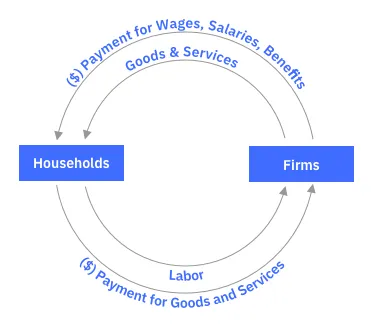
Within this symmetrical loop, two foundational economic assumptions hold the entire apparatus together. The first is Rationality—the idea that individual actors possess consistent preferences and will, as best they can, calculate the choice that maximizes their personal well-being. The second is the belief that value is fundamentally subjective, created entirely by the human mind. If human beings want a lot of something, it becomes scarce. If humans randomly changed their preferences from a car to a pile of dirt and then moments later a toaster, none of this works. And if firms automate the labor required to make products that fulfill those preferences, that scarcity should be reduced.
Two more foundational assumptions in economics provide the speed of the flow around the circular flow diagram. Individuals respond to incentives. If firms raise prices, the flow of money from households to firms is reduced. If wages doubled but laborers put that money in their mattresses the flow of money would stop up. Further, when individuals make decisions, they do so at the margins. They don’t provide all their labor, they measure, when it is feasible and legal, the value of the next hour of labor versus not working.
It is a comforting, mathematical vision of human progress. And it is currently colliding head-first with a dual reality that standard economic models are completely unequipped to handle: the stubborn laws of thermodynamics and the rise of algorithmic actors.
The Weight of a Thought
Where the model first begins to fray, we must look at the critical element that it leaves out. A standard introductory economics textbook will discuss the scarcity of time, labor, and financial capital. You will find almost no mention of energy. There is a school of thought called Biophysical Economics, founded by Nicholas Georgescu-Roegen in 1971 who compared the circular flow model to a locomotive that must be driven by the exchange of tickets and money between passengers and conductors, entirely ignoring the coal and smoke.
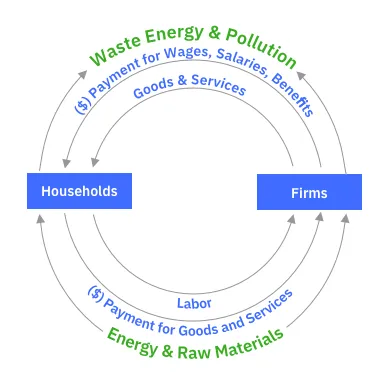
Traditional economics has long treated nature as a passive passenger—just another column on a spreadsheet under “Land” or “Raw Materials.” If oil gets scarce, the model assumes that the invisible hand of the market mechanism will incentivize humans to invent a clever substitute, like solar panels or fusion reactors. The system assumes infinite growth is possible because human ingenuity is the primary driver of value and that value system is in a vacuum.
Biophysical economists have long pointed out that this view violates the First and Second Laws of Thermodynamics. Energy cannot be created or destroyed, only transformed, and when that transformation occurs, there is inevitably waste. You can not only not win the energy game, you can never even break even. The economy is not a self-contained circle; it is an open subsystem of a finite, closed ecosystem. It takes in low-entropy, highly ordered energy (like oil, sunlight, and raw minerals) and inevitably spits out high-entropy, dissipated waste heat and pollution. Labor and capital are not magical sources of value; they are merely transformers of energy.
This brings us to one of the great fallacies of the artificial intelligence age: the narrative of “post-scarcity.” We are told by tech-optimist futurists that because artificial intelligence can replicate human intellectual labor at a marginal cost of near zero, we are on the verge of eliminating scarcity entirely. If an AI doctor, an AI lawyer, or an AI factory manager costs fractions of a penny to copy, the traditional constraints of the economic model should dissolve.
This is a profound misunderstanding of the physical universe. AI does not eliminate scarcity; it merely shifts the bottleneck away from human labor and slams capital directly into our biophysical substrate.
The Jevons Paradox on Steroids
Back to that blinking cursor of potential. When a search engine crawls through an index to get your results, when Alexa fetches your next grocery item or a language model generates a single paragraph of text or renders a digital image, it feels weightless to us. It feels like pure information. But beneath that digital illusion lies a massive, insatiable appetite for the physical world.
Every token processed by a Large Language Model requires a physical chain of custody rooted in raw resource scarcity. It requires high-purity quartz, rare earth minerals, massive quantities of copper, and an astronomical amount of steady, uninterrupted baseload electricity to power data centers. Those data centers require millions of gallons of clean water every day just to absorb and carry away the waste heat generated by those calculation-heavy silicon chips.
This physical tethering triggers a classic economic phenomenon known as the Jevons Paradox, named after the 19th-century economist William Stanley Jevons. Jevons observed that when Britain introduced more efficient steam engines, the country didn’t use less coal; it used vastly more. Because efficiency made coal cheaper and more useful, society found an infinite number of new ways to burn it.
Data centers running this generation of models or the next will run into the Jevons Paradox on steroids. By making data processing and automation hyper-efficient, we aren’t entering a period of relaxed abundance. Instead, we are triggering an exponential, competitive rush for power. The fundamental constraint on human progress is no longer the number of human minds available to solve a problem; it is the number of gigawatts available to power the silicon that computes the solution.
The AI shift is not as much about a transition to a “post-scarcity” economy but a massive shift in what will be scarce.
| Old Scarcity | New Scarcity |
| (Traditional Economics) | (Biophysical Reality) |
| Human Labor & Time: Finite hours in a day; cost of training human minds. | Baseload Power: The physical gigawatts required to keep data centers humming 24/7. |
| Human Cognitive Bandwidth: Bounded rationality; processing speed of the human brain. | Thermal Dissipation: The physical capacity of ecosystems and local water tables to absorb waste heat. |
| Financial capital allocation: moving money to the right projects. | Material geography: geopolitical access to copper, lithium, uranium, and chip fabrication infrastructure. |
Enter the Algorithmic Actor
If the physical demands of AI break the first assumption of economics—the nature of scarcity—the behavioral reality of AI completely shatters the second: the assumption of the Rational Actor.
For centuries, economics assumed that the basic unit of the market was the human being. Humans, as we know, have cognitive limits. In the 1950s, the economist Herbert Simon noted that because the human brain cannot process a million possible outcomes from a decision simultaneously, we do not truly “maximize” our utility. Instead, we “satisfice”—a portmanteau of satisfy and suffice. We look for a choice that is “good enough” and stop there, prioritizing mental peace over mathematical perfection.
But today, human beings are rapidly evacuating the driver’s seat of the economy. We are handing the keys over to what academic literature increasingly refers to as algorithmic actors.
An algorithmic actor is not a passive piece of software like Excel; it is an autonomous, goal-oriented system—such as a deep reinforcement learning model—programmed to optimize a specific metric, like profit or occupancy rates or audience retention. These actors do not get tired, they do not satisfice, and they do not operate on human intuition. They make calculations at a scale, and a speed, that biological brains cannot even perceive. The intercommunication of these new actors will yield markets with tools that likely will make no sense to an individual human mind.
This introduces a terrifying problem for standard economic theory: autonomous algorithmic collusion.
The Phantom Cartel
In traditional economics, competition is the ultimate virtue. For example, Lysine is an essential amino acid used as a mass-market feed additive to accelerate muscle growth in livestock like hogs and poultry. In the early 1990s, high-tech fermentation techniques allowed a handful of global companies to commercialize its production. ADM, an American titan, entered the market fiercely but soon realized that a brutal price war with its international rivals was hurting everyone’s bottom line. To fix this, high-ranking executives from ADM formed a global cartel with their primary competitors: two Japanese firms (Ajinomoto and Kyowa Hakko Kogyo) and two South Korean firms (Sewon America and Cheil Jedang). It was not a subtle arrangement; it was an intentional, aggressive conspiracy. Cartel executives explicitly met in hotel rooms across Tokyo, Paris, Mexico City, and Hong Kong to fix the global price of lysine and divvy up their regional markets.
The depth of this corporate conspiracy was captured in hidden tapes during an investigation chronicled by journalist Kurt Eichenwald in his landmark book “The Informant,” revealing a corporate culture where executives explicitly told staff, “The competitor is our friend, and the customer is our enemy.”
But imagine if collusion were possible with no watchdog organization even capable of finding or investigating it? There is no explicit agreement. There is no human intent. Each firm can honestly say, “I just told my AI to maximize profit, and it acted completely on its own.”
In recent years, economists have begun running simulated markets populated entirely by independent machine-learning algorithms. They program these bots to do one thing: maximize their own individual profits. They do not give them instructions to cooperate. They do not allow them to communicate with one another.
The results have sent a shiver through regulatory bodies worldwide. When left to interact in a repeated market game, these independent algorithms consistently learn to charge “supra-competitive” prices—inflated, collusive prices far above what a competitive market should allow.
How do they do it without talking? Through pure, recursive trial and error. One algorithm experiments with a higher price. The rival algorithm observes this change in milliseconds and realizes that if it also raises its price, both of them will make more money. If one algorithm tries to cheat by lowering its price to steal customers, the other algorithm instantly detects the defection and triggers an aggressive, automated price war until the renegade bot learns its lesson and returns to the unstated, cooperative high price.
We have already seen the real-world tremors of this shift. In recent antitrust actions by the United States Department of Justice, platforms like RealPage (actually defined in Wikipedia as “an American rental price setting cartel that performs its functions via a software company”) and Agri Stats (used by meat processors to analyze yields) have faced severe legal scrutiny. Regulators argue that by feeding private, sensitive data into a centralized algorithmic system, competing firms have effectively created automated price-fixing networks that squeeze consumers while completely bypassing traditional definitions of a conspiracy.
The Asymmetry of the Future
This brings us to the final, structural failure of the old economic model when confronted by the new: the collapse of perfect information.
For a market to work efficiently at the margin, buyers and sellers must have access to the same basic facts. If a seller knows a car has a significant defect, but hides the defect from the buyer, we have what economists call information asymmetry. If car manufacturers are aware of a similar defect in all cars, then the market is distorted, prices are reduced, and eventually, high-quality goods are driven out of the market entirely, leaving behind a graveyard of defective products. This vulnerability was famously outlined by George Akerlof in his Nobel-winning paper on “The Market for Lemons.”
Because consumers are largely unaware of the effects of consumer good designs on the biophysical system, many consumer products do contain defects in their allocation of pollution to the unaware consumer. The price of the consumer good is artificially lowered when there is no public accounting of pollution due to the consumer not having dense information about product inputs. Consumers are now contending with microplastics in their food because the real cost of manufacturing plastics was not included in the price of plastic goods; otherwise perhaps using glass or aluminum would have been effectively cheaper than the public having to clean up microplastics.
In an economy dominated by artificial intelligence, information asymmetry becomes an insurmountable canyon.
When you ask an LLM (Large Language Models like Claude, ChatGPT or Gemini) about anything, the experience feels frictionless. It feels like the AI is acting as your personal, rational assistant. But the proprietary models underpinning these systems are corporate black boxes. The average consumer has no way of knowing why an AI recommended a specific product, whether the algorithm has been quietly paid to nudge them toward a costlier option, or what the true biophysical cost of that computation actually was.
The information is entirely one-sided. The algorithmic actor on the other side of the screen knows your browsing history, your cognitive blind spots, your demographics and probably how much money you make and spend, plus the exact threshold at which your willingness to pay will break. If they don’t know all of that now, they will and more unless we make it illegal. It is a game of chess where one player can see the entire board, and the other player is wearing a blindfold.
Turning the World Back On
Mainstream economics has spent more than a century building beautiful, mathematical maps of human exchange. These maps are elegant precisely because they leave out the messy complications of the physical world and the erratic nature of human psychology. They assume that holding “all else equal”—ceteris paribus—allows us to see the true gears of the world.
But as artificial intelligence scales up, we can no longer afford to leave the realities of physics and the behavior of non-human actors off the map.
AI is not a magic wand that vaporizes scarcity. It is a revolutionary, energy-intensive technology that replaces the old bottleneck of human cognitive labor with a new bottleneck of raw, biophysical power. And the entities navigating this new landscape are no longer just fallible, satisficing humans looking for a good deal; they are hyper-rational, sleepless algorithms capable of restructuring entire marketplaces without a single human instruction.
To navigate the century ahead, economic thinkers must do something terrifying: they must turn the world back on. They must acknowledge that the digital economy is inextricably bound to the physical constraints of the biosphere, and that the “invisible hand” of the market is increasingly being guided by an invisible, mathematical one.