Table of Contents
April 23, 2026
Welcome to the MediumocracyApril 15, 2026
Non-human Citizens United?April 9, 2026
The Humble HyperlinkApril 2, 2026
The Hare Is Running Away With Your Data But the Tortoise Has a ShellMarch 23, 2026
Language == (Code && 💕)March 20, 2026
Notes on Cognitive LibertyMarch 20, 2026
From Tulips to Transformers: A Brief History of Expensive MistakesMarch 18, 2026
DoomtubersMarch 18, 2026
The Private MindMarch 16, 2026
The Fluency IllusionMarch 16, 2026
The Map Is Not the TerritoryMarch 16, 2026
The Modular MindMarch 16, 2026
Who Named These Animals?March 4, 2026
Align AI? Try Aligning HumansFebruary 22, 2026
This AI Cannot Be EmpireFebruary 14, 2026
Unsubscribe & ResistJanuary 26, 2026
The ContentkeeperApril 11, 2025
Review: The Idea FactoryMarch 26, 2025
Whither Apple Intelligence?March 19, 2025
Let’s Call Them Answer EnginesMarch 11, 2025
DoomtubersMarch 4, 2025
“It’s not A.I., It’s the Non-Economy of Content, Stupid.”January 25, 2025
The Lasting Creak of Legacy CodeJanuary 26, 2005
Weaponizing Bits

Welcome to the Mediumocracy
 R. E. Warner
 Dept. of Made You Look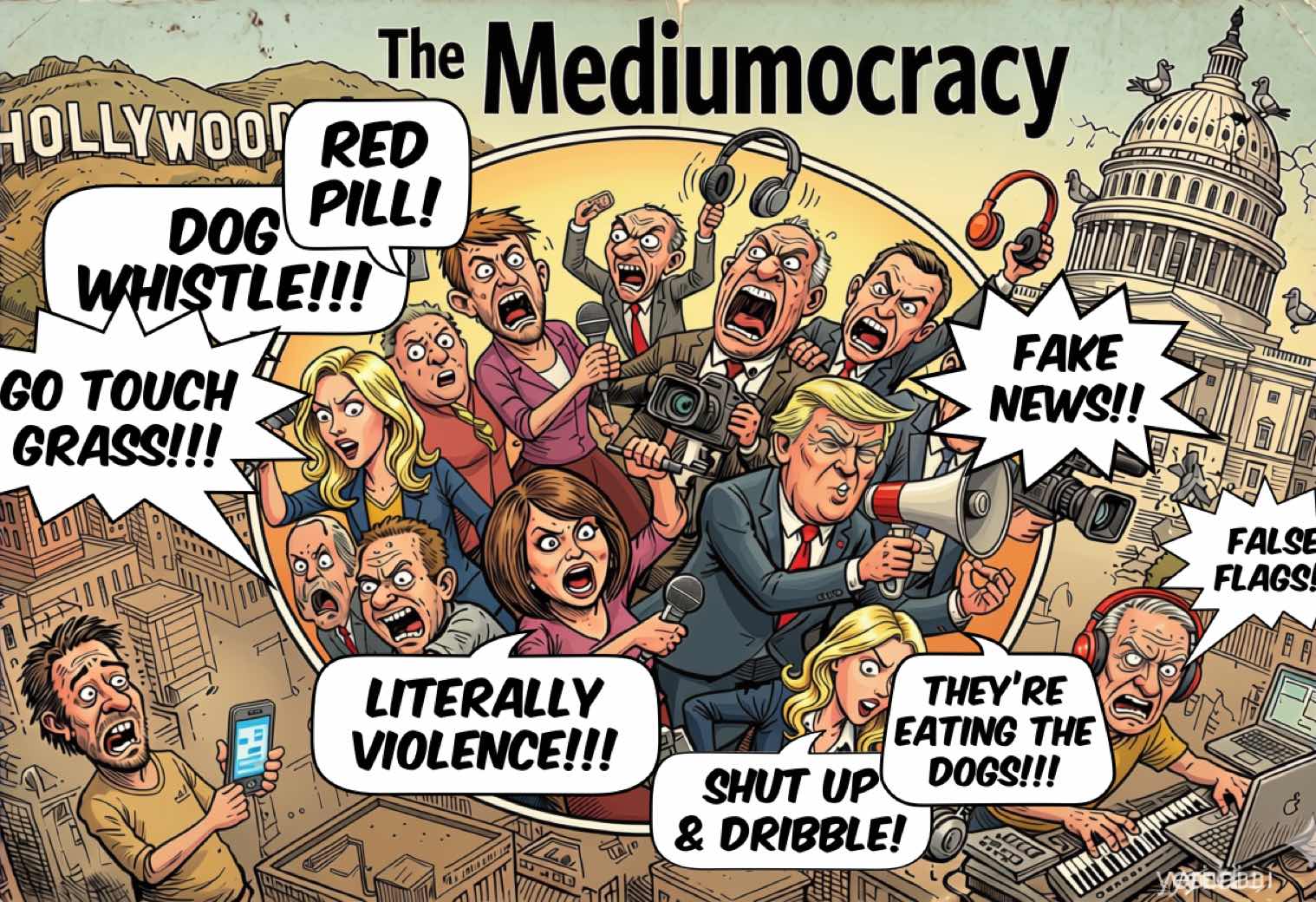
Welcome to the Mediumocracy
Social media abhors expertise. Not by design—no one held a meeting and decided that—but by structure. Yuval Noah Harari’s Nexus makes the mechanism clear: information networks become dangerous when they optimize for speed and reach rather than truth-testing. Truth is expensive in work sense. (Or it should be if you want to trust the information; another reason large language model aren’t all that.) Peer review, professional licensing, regulatory oversight—all of it exists to stress-test claims against each other, to build in friction, to make it hard to be catastrophically wrong without someone in an adjacent office noticing. That process is slow and annoying and occasionally captured by the wrong people. It is also the only mechanism humanity has developed that reliably separates what is true from what merely feels true. You know, truthiness.
The short-form internet nuked all of that.
It’s not just that misinformation spreads faster than truth—it does, reliably, at scale, across every platform studied. A deeper effect is structural. A celebrity with a large following has a direct pipe to millions of people with no editors, no peer reviewers, no departmental colleagues, no obligation whatsoever to update when the evidence changes. They are in front of the classroom and the whiteboard—as we’ve noted elsewhere—but have none of the institutional scaffolding that made the classroom trustworthy.
The intimacy of the medium is the con.
When someone looks you in the eye through a phone screen and delivers a confident take on vaccine safety or epidemiology or the mechanics of government, the brain registers that as conversation. It is not conversation. It is broadcast dressed up in intimacy’s clothes. Celebrity compresses all of that institutional friction into a single node. One voice. One vibe. The authority signals survive intact. The accountability structures do not.
The Warm-Up Act
Celebrity has always nudged at the edges of governance. Ronald Reagan spent years in California politics before the White House. Jesse Ventura had a colorful and arguably coherent political identity before becoming governor of Minnesota. These were exceptions, and the guardrails held—not because the system was wise, but because the media environment hadn’t yet selected hard against expertise.
Dr. Oz arrived as a transitional figure—a celebrity adjacent to expertise and fame (via Oprah), borrowing the authority of a medical credential while systematically hollowing it out.
Quick rule of thumb: if a doctor in an advertisement is charging you for health information, it’s a scam. Not probably a scam. A scam. The AMA’s code of ethics holds that a physician’s primary obligation is to the patient, and that financial incentives shouldn’t distort clinical judgment. Even if they are selling you something that works, profit comes before you. The medical industry is awash in this problem right now.
Gwyneth Paltrow built a wellness empire on the aesthetic of expertise—the clean lines, the authoritative tone, the implication that she had access to knowledge your actual doctor didn’t. Jenny McCarthy prosecuted a years-long campaign against childhood vaccination with no medical training whatsoever. Measles is now making a comeback.
Meanwhile, in November 2014, a sixteen-year-old named Jaden Smith sat down with the New York Times to share his views on education. “You never learn anything in school,” he explained, having never attended one. The clip went viral. Educators were furious—it landed on the desk of the National Dropout Prevention Center with enough force to rattle the furniture. But the fury missed the real question: why was a sixteen-year-old with no experience of ordinary school given a national platform to pronounce on education in the first place?
The answer is: his father is Will Smith. That’s the whole answer. And the medium didn’t care.
Look, Not All Famous People Are Idiots
Let’s get something out of the way, because it matters to the argument.
This is not a shut-up-and-dribble piece. The argument that famous people should stay in their lane and leave governance to the professionals is a little too convenient. Intelligence is roughly a normal distribution across all human populations, including famous ones. Hedy Lamarr invented the frequency-hopping technology that became the foundation of WiFi and Bluetooth—and the U.S. Navy ignored her patent for decades because she was a movie star. Mayim Bialik plays a neuroscientist on television and has a Ph.D. in neuroscience from UCLA—which means she is, technically, more qualified than the show. Milla Jovovich recently co-built MemPalace, currently the highest-benchmarking open-source AI memory system available. There is room in this world for geniuses, and they show up in unexpected places.
Most people, however, are not geniuses. That’s not an insult. That’s what the word means. Do we, as an audience, filter our fact-finding on the Internet accordingly?
The problem isn’t that celebrities are stupid. The problem is that becoming famous is a full-time job. A career in media—building an audience, maintaining a public presence, staying relevant—consumes exactly the kind of time that expertise also requires. Malcolm Gladwell’s famous 10,000-hour threshold was already a simplification of Anders Ericsson’s research on deliberate practice—and even Ericsson’s number is a floor, not a finish line. Genuine domain expertise in law, epidemiology, military doctrine, or intelligence operations runs orders of magnitude higher, and the hours have to be the right kind of hard. Hours spent becoming a household name are hours not spent understanding how infectious disease spreads, or how a defense budget works, or what the CIA actually does. The math is simple and it is brutal and social media seeps right through the cracks in knowledge gathering like an acid.
So when we put celebrities in charge of things that require expertise, we are not making a mistake about individual people. We are making a categorical error. We are confusing the signal—fame, broadcast reach, the quality of being-known—with the substance. And here’s the thing: we didn’t arrive at that confusion by accident. We were trained into it.
The Trust Collapse and the Vacuum It Left
And the numbers bear this out. The share of Americans expressing the strongest level of trust in scientists fell from 39% in 2020 to 23% by late 2023. Among Republicans, nearly 40% said they had little or no confidence in scientists to act in the public interest—up from 14% at the start of the pandemic. Trust in the FDA and state public health officials each dropped by double digits. Trust in the federal government to do the right thing—22% as of spring 2024, near a sixty-year low. Is it people developing mistrust or mistakenly believing they and their celebrity priests know better than experts?
The Apprentice Was the Training Data
There’s a phenomenon researchers call the CSI Effect: two decades of forensic procedural television convinced a significant portion of the American public that real police work resembles what happens on CSI—instantaneous DNA results, infallible forensic scientists, cases solved in forty-two minutes plus commercials. Jurors began demanding evidence that doesn’t exist in real crime scenes, because television had trained them to expect it. The medium didn’t just carry the content. It shaped what the audience believed was normal.
The Apprentice ran the same operation on executive competence.
For fourteen seasons, Donald Trump performed the aesthetic of decisive leadership—the boardroom, the firing, the theatrical certainty that the right answer was always obvious and he always had it. This is not a coincidence to be noted and moved past. This is the mechanism. The show didn’t just make Trump famous. It trained millions of viewers to recognize what executive authority was supposed to look like. And what it was supposed to look like was him.
But here’s what makes this more than a story about one television show—or one man. Simultaneously, social media and short-form content were rewriting the selection pressures for public attention across every domain. The traits that make someone successful on these platforms—parasocial intimacy, emotional legibility, charisma at scale, the ability to hold attention in under sixty seconds—became the same traits that make someone politically viable. The environment didn’t just allow celebrity to migrate into governance. It selected for it. Evolution doesn’t have intentions. It just rewards what survives.
McLuhan would have recognized this without blinking. The medium isn’t just the message—it’s the hiring committee. When the primary medium of public life became one that rewards performed authenticity over demonstrated competence, performed authenticity was what got hired. We didn’t decide to elect celebrities. We built an environment that made celebrities the fittest organisms, and then we held an election.
The Ledger
Let’s look at what we’ve actually done.
Pete Hegseth—Fox News host, Secretary of Defense. Robert F. Kennedy Jr.—anti-vaccine activist, Secretary of Health and Human Services. Kash Patel—author of a children’s book about the “Deep State,” Director of the FBI. Jeanine Pirro—Fox News judge, U.S. Attorney for Washington D.C.. Linda McMahon—WWE CEO, Secretary of Education. Kari Lake—television news anchor, Director of Voice of America. Elon Musk—owner of a social media platform, informal co-head of an advisory body with real authority over federal agencies.
This is not a rant. It’s a ledger. What each of these roles actually requires—expertise in military operations, epidemiology, intelligence tradecraft, federal law, education policy, international broadcasting, government efficiency—is not what each of these people has demonstrably 40k+ hours doing. The gap is not a matter of opinion. It is a matter of time and arithmetic.
And then there’s Kristi Noem, who is a slightly different case—not a celebrity appointed to govern, but a politician who learned to perform celebrity so completely that she forgot which one was the job. As Secretary of Homeland Security she conducted ICE raids in full makeup and a bulletproof vest, then drove straight to Fox News in a different outfit. She piloted a Coast Guard vessel. She rode a horse at Mount Rushmore for a $220 million DHS advertisement. A congressional Democrat thanked her for finding time “among your many photo ops and costume changes to testify.” She lasted fourteen months. The medium had colonized the mission so thoroughly that the mission disappeared.
To be clear, this is not a left-right issue. Gavin Newsome has been having a lot of fun on Twitter. Zohran Mamdani is praised for his mastery of social media. Left or right, it’s clear that Joe Rogan, Bill Maher, and—I can’t dignify this celebrity with a name check, call her What’s-Her-Butt—are currently more influential with the President than most lobbyists or policy advisors. Not because they got smarter. Because the room got noisier and they have the biggest speakers. Even the President is an audience member who does not understand the value of expertise.
What Is Parasocial Loyalty But Royalty?
Here’s the thing that should unsettle you: none of this is new. What we’re calling the celebocracy or the mediaocracy or what I’m calling the mediumocracy, or the Barnum administration, pick your term—is not a collapse into something strange. It is a collapse backward into something very, very old.
Monarchy ran on exactly this dynamic. Millions of people with a profound, one-sided emotional investment in someone they would never meet, whose decisions shaped their lives, who owed them nothing in return. The peasants knew everything about the king’s court—the intrigues, the exploits, the fashions, the feuds—and the king knew nothing about them except that they existed in aggregate and could be taxed. Parasocial relationships didn’t begin with YouTube. They began with divine right.
Celebrity culture didn’t invent this structure, but social media let them industrialize it. And then the internet personalized it—gave it the illusion of two-way contact, the feeling of intimacy, the parasocial warmth of being-known-by. At least with royalty, the asymmetry was legible. The celebrity looks you in the eye through the screen and says we. Joe Rogan doesn’t have subjects. He has listeners. That’s the upgrade. That’s also the con.
The meritocracy experiment—credentials, peer review, institutional vetting, the slow expensive apparatus for stress-testing whether someone actually knows what they claim to know—was the interruption. The anomaly in the historical record. We built it because the alternative, which is rule by whoever commands the most intense one-sided devotion, had a documented track record of spectacular failure. We are now, methodically, dismantling out experiment. Not because anyone decided to. Because the medium selected for it.
This Too Shall Pass. Slowly.
P.T. Barnum called in the freaks, and the crowds came. They always do, for a while. There is a reason Barnum is not remembered as a statesman.
Movements like #ResistAndUnsubscribe are natural reactions to performative incompetence—people instinctively withdrawing attention from systems they’ve recognized as extractive. These movements are real. They are also, themselves, fads, subject to the same attention dynamics they’re reacting against. Popular resistance to celebrity governance, organized on the platforms that created celebrity governance, does not escape the medium.
The tide will change. Not because people will suddenly come to their senses, but because the regulatory and legal environment around the platforms is shifting. Courts have begun finding against Meta and YouTube in ways that suggest the environment that created this selection pressure may itself be subject to selection pressure. The landscape changes slowly, then quickly. The institutions that were built to interrupt the last version of this problem are still here, battered and underfunded and occasionally captured by the wrong people, but still here.
The medium created the mediumocracy. Changing the medium is the only repair that works. Everything else is a costume change.
The Daily Show gets it: Even the ”medium talent” have decided to get in the race.
Russell Warner writes about “minds on media” at Banapana and on Substack. Subscribe there to get pieces like this before they’re overtaken by events—which, at current rates, gives you about a week.